1949
THE BEGINNING
Golf Pride is born
Thomas Fawick, together with Bill Junker and Jim Karns, develops the idea of a golf grip made of moulded rubber. Golf Pride is founded.
Models, grip sizes, technologies, clubmaking, putter grips, care and regripping: our Golf Pride knowledge hub gives you practical know-how about one of the most important contact points between golfer and club.
You don't have to read the knowledge hub from top to bottom. Simply choose the topic that interests you and jump straight to the right chapter.
Start with models, grip feel and grip sizes.
From leather to rubber: history, development and milestones of Golf Pride.
Discover the brand →Compare Tour Velvet, MCC, ZGRIP, CP, Tour Wrap, V55 and other series.
Compare models →Firm, hybrid, tacky or soft: which grip feel suits you?
Understand grip feel →ALIGN, ALIGN MAX, Plus4, Cord, 360 and taper explained simply.
Explore technologies →Choosing correctly between junior, undersize, standard, midsize and jumbo.
Find your size →.580 vs. .600, butt diameter, tape build-up and grip weight.
Understand clubmaking →Reverse taper, zero taper, Pro Only and classic putter shapes.
Explore putter grips →Recognising wear, regripping intervals and professional installation.
Understand regripping →Clean and dry golf grips properly and protect them from heat.
Explore grip care →The most important questions about Golf Pride answered in brief.
Open FAQ →To get started, three topics are often enough: choose a model, define your grip feel and find the right size.
Then go straight to our Golf Pride category and choose models, sizes and variants.
Today Golf Pride is one of the best-known names in golf grips. Yet the brand's story began with a fairly simple question: does a golf grip really have to be made of leather?
In the 1940s, leather grips were widespread in golf. Inventor and golf enthusiast Thomas Fawick, however, saw potential in a different material: rubber.
Compared with the leather constructions of the time, rubber could offer advantages in durability, traction and consistent manufacturing. In Akron, Ohio – then one of the most important centres of the American rubber industry – Fawick developed his idea further together with Bill Junker and Jim Karns.
This led to the founding of Golf Pride in 1949.
Modern golf grips have to be manufactured consistently, offer sufficient traction and feel as constant as possible in different conditions. Moulded rubber compounds opened up completely new possibilities in structure, hardness, profile and surface design.
Some Golf Pride developments have shaped not only the brand itself but also how golf grips are designed, installed and replaced today.
Thomas Fawick, together with Bill Junker and Jim Karns, develops the idea of a golf grip made of moulded rubber. Golf Pride is founded.
Moulded rubber grips develop into a high-performance alternative to traditional leather grips. Structures and surfaces can now be developed and reproduced more precisely.
The development of the slip-on rubber grip made installation considerably easier. A worn grip no longer had to remain part of a construction permanently built onto the shaft.
This created an essential foundation for today's professional regripping.
With the Victory, Golf Pride developed one of its best-known early grips.
Its distinctive design and the so-called “Grip Rite Swing Rite” orientation were intended, among other things, to help golfers position their hands on the grip more consistently.
In the mid-1990s the Golf Pride Tour Velvet became established.
The combination of rubber compound, distinctive plus-sign pattern and balanced feedback made it one of the brand's best-known golf grips.
Modern Golf Pride grips have long differed in more than just colour or design.
Materials, cord content, taper, grip diameter, surface textures, reminder systems and different rubber compounds allow a much more individual choice.
The history of Golf Pride shows how the role of the golf grip has changed: from a simple contact piece between hand and shaft to a technically tuned component of the golf club.
For us at Tesi Golf, the name on a grip is therefore not the only thing that matters. What matters is how grip size, material, weight, surface texture and build-up suit the player and the club.
Different rubber compounds, cord and hybrid constructions change feedback, comfort and traction.
Textures and patterns influence how secure a grip feels in dry or wet conditions.
Undersize, standard, midsize and jumbo are different starting points for fitting.
Technologies such as cord, Plus4 or ALIGN take different approaches to grip feel, profile and orientation.
A high-quality golf grip alone does not make an optimal setup.
Only when grip model, size, core size, tape build-up and weight suit the shaft and the player does the grip become a properly tuned component of the golf club.
Tour Velvet, MCC, ZGRIP, CP, Tour Wrap and more: in the next chapter we compare the most important Golf Pride product families.
Tour Velvet, MCC, ZGRIP, CP, Tour Wrap or V55: the Golf Pride model families differ significantly in material, surface texture, grip feel, moisture control and construction.
A grip can be very direct and firm or soft and comfortable. Some players prefer a heavily textured surface, others want as much tack and as smooth a feel as possible.
That's why we don't see the Golf Pride range as a ranking. The much more important question is: Which characteristics suit your hands, your game and your personal preferences?

The classic Golf Pride all-round grip with balanced feedback and the distinctive plus-sign surface.
Cord in the upper section meets performance rubber in the lower section – two different zones within one grip.
Firm, direct grip feel with a pronounced surface texture and a performance focus.
The comfort-oriented Golf Pride family for players who prefer a softer grip feel and more damping.
Classic wrap look combined with modern rubber construction and a particularly tacky grip feel.
Cord, plus-sign texture and classic Golf Pride design elements combine modern performance with the brand's history.
A first orientation – the actual grip feel always remains a personal decision.
| Family | Character | Feel | texture | Particularly interesting for |
|---|---|---|---|---|
| Tour Velvet | All-round | balanced | medium | a wide range of players |
| MCC | Hybrid | direct / two-zone | high | performance & moisture control |
| ZGRIP | Performance | firm | high | maximum feedback |
| CP | comfort | soft | comfort-oriented | damping & softer feel |
| Tour Wrap | wrap | soft / tacky | wrap texture | high tack & classic feel |
| V55 | cord / heritage | direct | high | traction & classic cord feel |
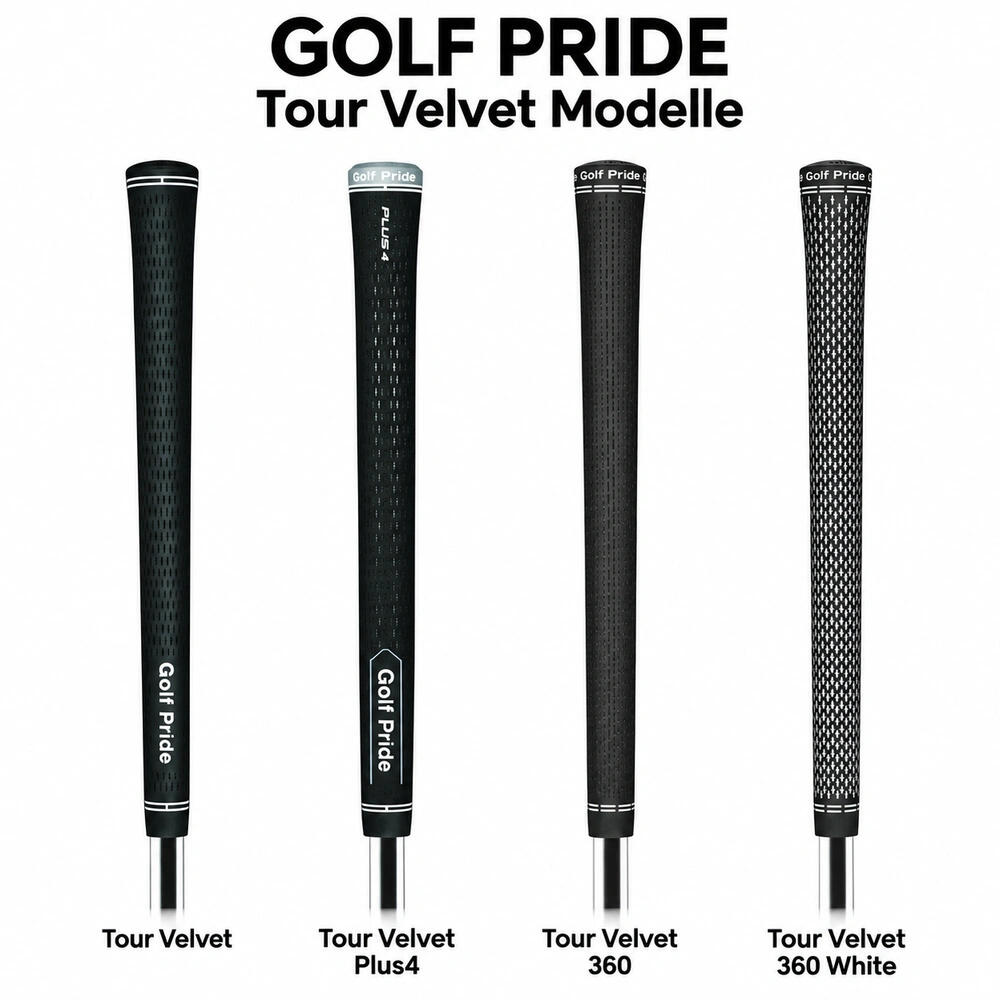
A balanced grip feel, a distinctive plus-sign texture and numerous variants make Tour Velvet one of the core Golf Pride families.
The surface uses an even plus-sign pattern that creates additional contact points between hand and grip.
Its grip feel sits between very soft comfort grips and particularly firm performance grips.
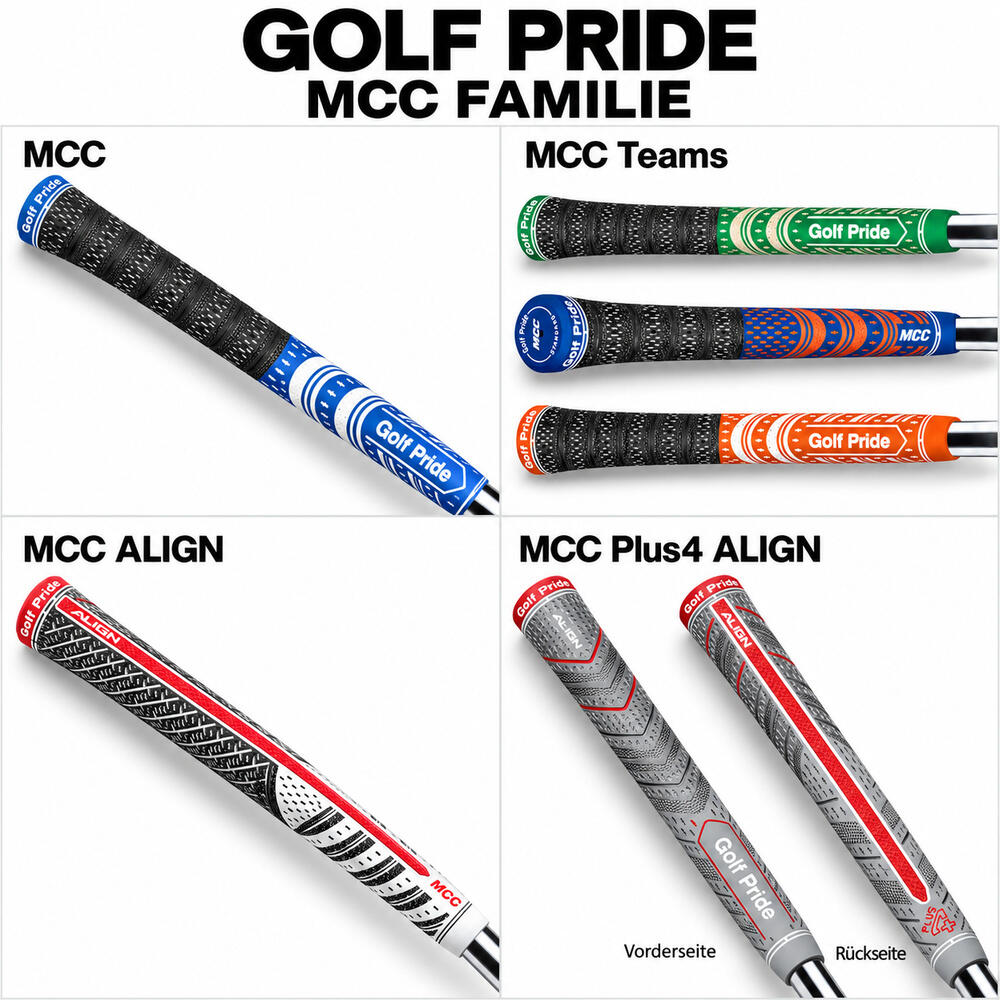
MCC stands for a hybrid approach: cord and rubber are deliberately combined within one grip.
In the upper section, MCC combines rubber with brushed cotton cord. This supports traction and moisture management.
In the lower section, performance rubber puts more emphasis on feel and feedback.
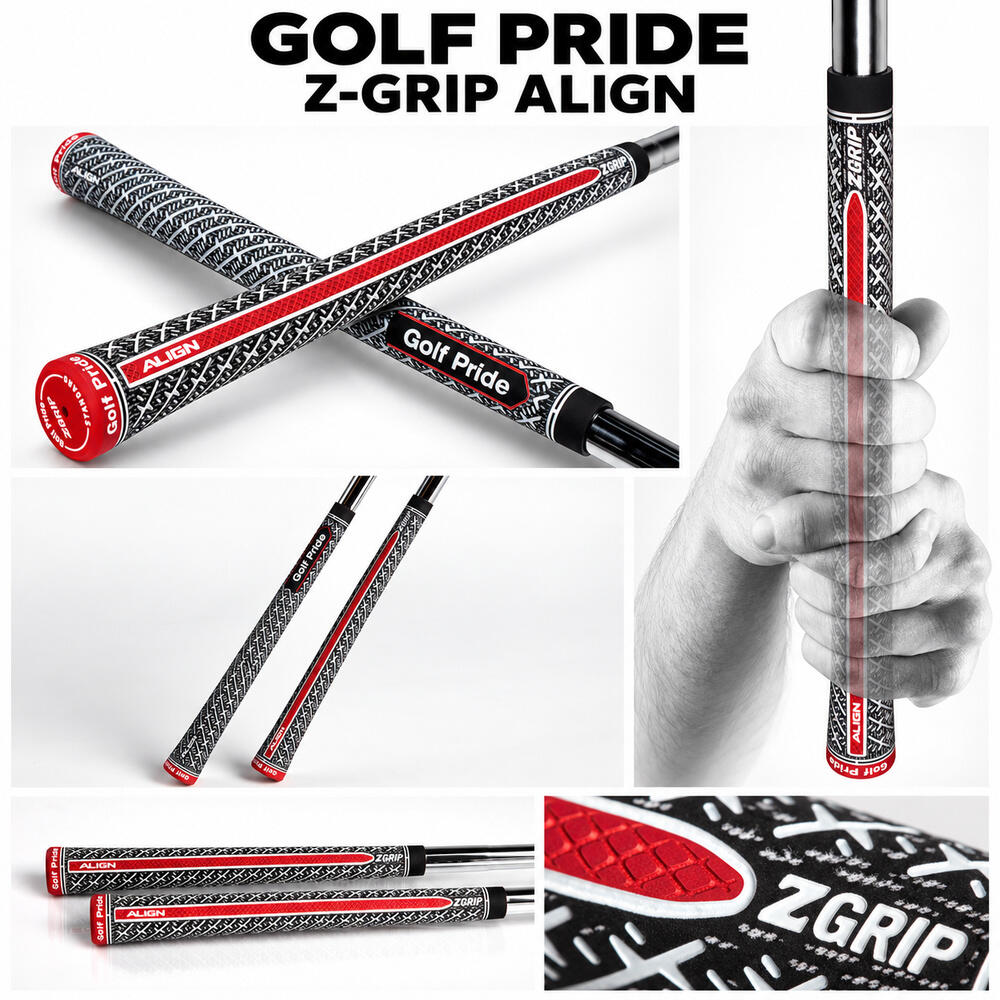
The ZGRIP family is aimed at players who prefer a more pronounced texture and a firmer grip feel.
A firmer grip dampens the feel at impact less than a particularly soft comfort grip.
The pronounced texture additionally supports the connection between hands and grip.
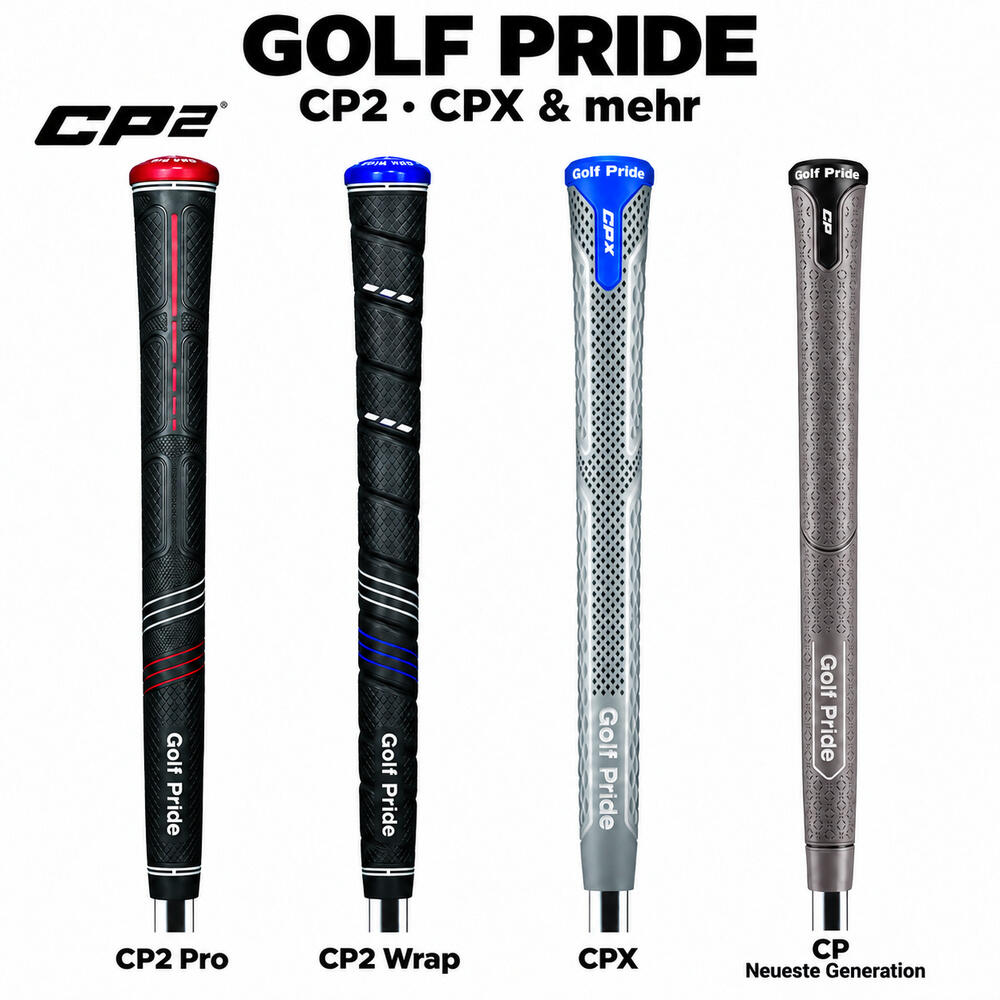
The CP family is the softer side of the Golf Pride range, combining comfort-oriented rubber compounds with modern surface textures.
Players who find classic or cord grips too hard will find softer alternatives within the CP family.
Different CP generations combine comfort with tack, surface texture and reduced taper, among other things.
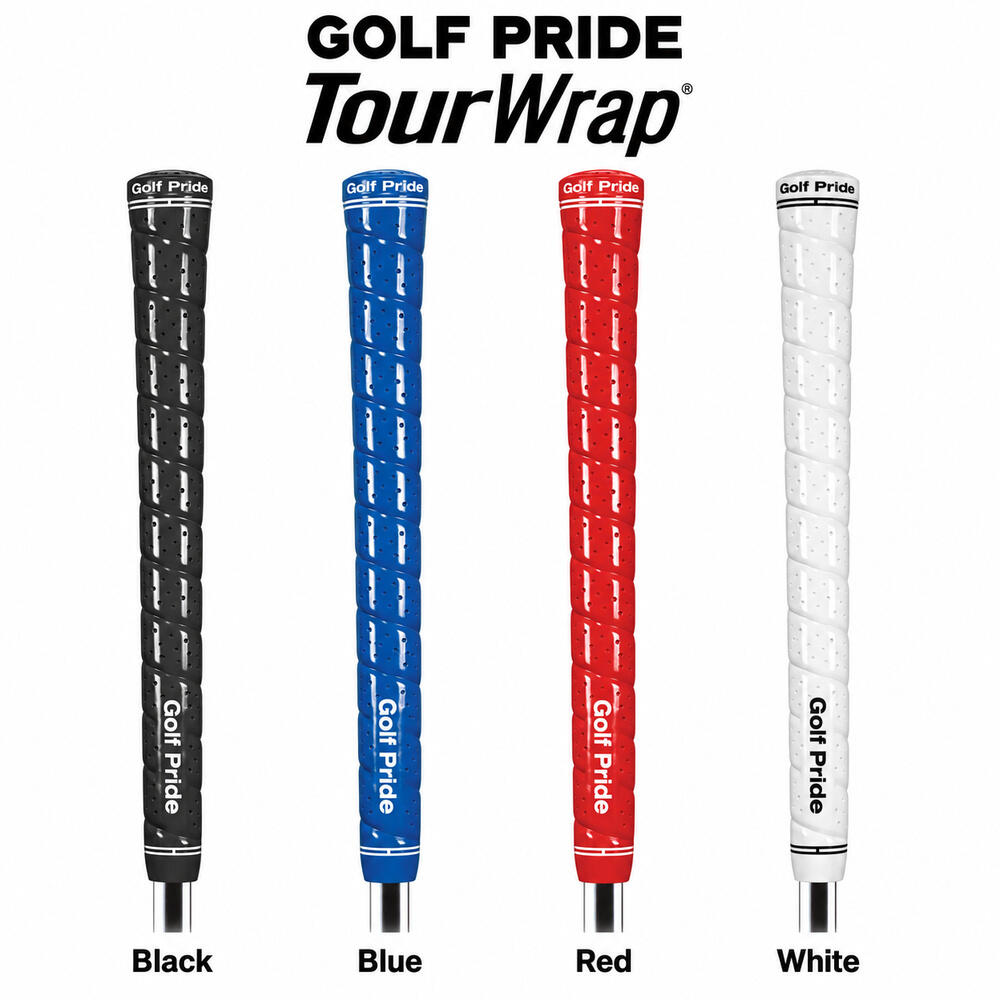
Visually, Tour Wrap is reminiscent of traditionally wrapped grips – technically, it is a modern grip construction.
Tour Wrap relies more on a sticky-feeling, smooth surface than on a particularly rough texture.
This creates a noticeably different hand feel from MCC or ZGRIP.
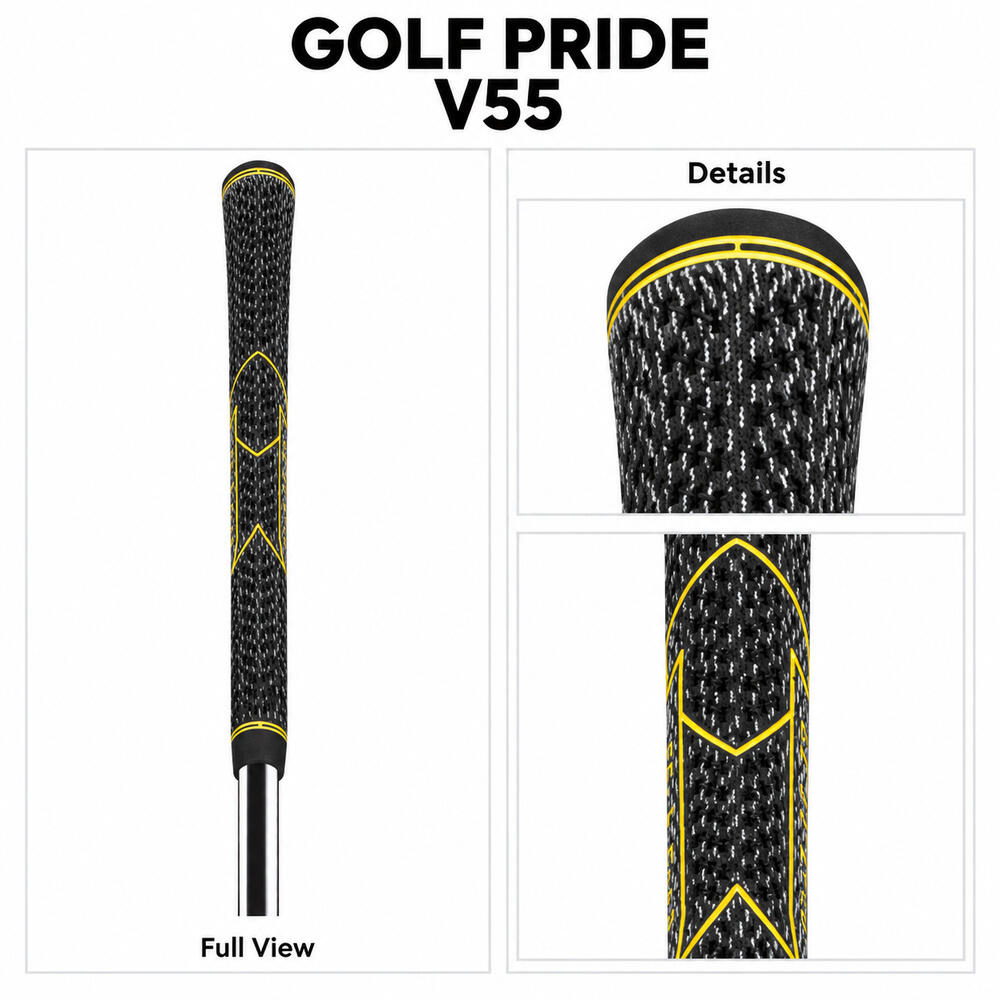
V55 picks up historic Golf Pride design ideas and combines them with a cord-rubber construction.
Brushed cotton cord supports moisture control, while the familiar plus-sign pattern adds extra texture.
A classic Grip Rite Swing Rite design element also serves as a visual reference for hand position.
Two players can use the same Golf Pride grip and still get a different grip feel.
Grip size, shaft diameter, core size, tape build-up and even grip weight influence the finished setup.
In our Golf Pride category you'll find available models, sizes and variants.
Firm, hybrid, tacky or soft: in the next chapter we look not at model names but purely at the feel in your hands.
Two golf grips can be the same size and still feel completely different. Firmness, surface texture, tack and material influence the connection between your hands and the golf club.
Personal preference naturally plays a big role. At the same time, different materials and constructions have measurable effects on vibration damping, surface texture, moisture control and feedback.
That's why it pays to choose a golf grip not just by colour or model name.
A grip can, for example, be soft and tacky at the same time, or firm and heavily textured. That's why we look at several characteristics separately.
How much does the material give under pressure? Firmer grips transmit more immediate feedback, softer grips dampen more.
Tack describes the slightly adhesive, grippy feel of the surface. High tack can provide a lot of security, especially in dry conditions.
Patterns, recesses, cord and other surface textures create additional contact points between hand and grip.
Material and surface influence how well a grip copes with sweat, moisture and changing weather conditions.
Use this classification as a first point of orientation. Individual models within a group can still differ considerably.
Firm, direct and with little damping. For players who want as much feedback from the club as possible.
Understand firm → 02 TWO ZONESDifferent materials or zones combine different characteristics within a single grip.
Understand hybrid → 03 GRIPPY FEELA slightly adhesive surface creates a particularly grippy feel without necessarily being heavily textured.
Understand tacky → 04 MAXIMUM COMFORTSofter materials absorb more vibration and create a more damped grip feel.
Understand soft →Firmer golf grips transmit a greater share of the feedback from the club directly to the hands.
The material gives less under grip pressure. This creates a more precise, more immediate feel between hand and club.
Many firmer grips additionally combine this feedback with stronger texture or cord.
you want as much feedback as possible at impact and very soft grips feel spongy or overly damped to you.

Hybrid grips deliberately combine different materials and surface properties.
A typical example is the Golf Pride MCC. Cord is used in the upper section, while the lower section is shaped more by performance rubber.
This combines extra traction and moisture control with a different feel in the lower hand.
you like the traction of cord but don't want the whole grip to feel like a full-cord model.

Tack describes an adhesive, slightly sticky surface effect that can create additional traction.
A heavily textured grip can feel rough without being particularly tacky. A tacky grip, on the other hand, can appear relatively smooth and still cling strongly to the hands.
Especially in dry and moderate conditions, high tack can create a very secure grip feel.
Very tacky surfaces work particularly well when dry. When they get wet, their effect can decrease significantly. Cord and more heavily textured constructions then often have the advantage.
you like the feeling that the grip practically sticks to your hands and you don't want a very rough surface.
Softer golf grips absorb a larger share of vibrations and therefore give a more damped hand feel.
The extra damping can feel particularly pleasant. At the same time, it changes the direct feedback from the club.
That's exactly why there is no objectively better value: some golfers prefer maximum feedback, others deliberately choose more comfort.
firmer grips feel too hard or uncomfortable to you and you prefer a more damped, comfort-oriented feel.
| Feel | Main feature | feedback | damping | Example |
|---|---|---|---|---|
| Firm | firm & direct | high | lower | ZGRIP |
| Hybrid | material combination | differentiated | depends on model | MCC |
| Tacky | adhesive surface | depends on model | usually medium to high | Tour Wrap |
| Soft | comfort | lower | high | CP |
Grip diameter, tape build-up and the shaft under the grip also influence how firm and full the finished setup feels in your hands.
That's why in clubmaking we always consider the complete build-up and not just the product name on the packaging.
ALIGN, ALIGN MAX, Plus4, Cord and 360: the next chapter is no longer about how a grip feels in general, but about how its construction works.
Modern golf grips have long differed in more than material, colour or size. Golf Pride uses different constructions, grip profiles and surfaces to specifically influence hand position, traction, moisture control and grip feel.
ALIGN is something different from Plus4. Cord does a different job from a 360-degree surface design.
Some technologies change the shape of the grip, others the surface, and others again help with a consistent hand position.
That's why we look at each technology separately and explain when it can actually be interesting for a golfer.
A raised ridge on the back supports repeatable hand positioning.
Understand ALIGN → 02 MAXIMUM RIDGEHigher, firmer and longer: the more noticeable evolution of the ALIGN principle.
Understand ALIGN MAX → 03 GRIP PROFILEA larger lower grip section creates a profile with less taper.
Understand Plus4 → 04 TRACTIONCotton fibres within the grip surface increase texture and help with moisture management.
Understand cord → 05 HYBRIDDifferent materials and textures perform different jobs in the upper and lower grip sections.
Understand dual traction → 06 ALL-AROUND DESIGNA wrap-around design ensures a consistent appearance at different shaft orientations.
Understand 360 →ALIGN doesn't just change the look of a golf grip. There is a raised area on the back that you can feel.
The raised ridge runs along the back of the grip and can be felt with the fingers.
This gives the player an additional tangible reference for a repeatable hand position.
Correct alignment during installation is particularly important.
An ALIGN grip must be installed to match the desired clubface and shaft orientation. If the orientation is changed later, the position of the tangible ridge changes too.
ALIGN MAX follows the same basic principle as ALIGN but uses a more pronounced ridge.
Golf Pride describes the new ridge as higher, firmer and longer than the original ALIGN version.
This makes the orientation on the back of the grip easier to feel.
The longer ridge can also still serve as a reference when the player grips slightly higher or lower on the grip.
ALIGN MAX can be particularly interesting for players who find the classic ALIGN ridge not noticeable enough.
Plus4 deliberately changes the profile of the grip. The lower section has a larger outer diameter than a comparable classic taper.
In the lower grip section, the profile roughly simulates the effect of four extra layers of tape.
So the difference is not created by four actually installed extra layers of tape but is already built into the grip construction.
A Plus4 grip mainly changes the ratio between the upper and lower grip sections. A midsize grip, by contrast, increases the entire grip diameter.
Taper describes how the golf grip narrows from the top end towards the lower hand.
The grip becomes progressively thinner towards the lower end.
The lower section stays fuller. Plus4 is a typical example.
A clubmaker can influence the grip diameter and, to some extent, the taper profile with additional layers of tape.
In cord grips, textile fibres are integrated into the rubber construction and are visible and tangible on the surface.
Golf Pride uses cotton fibres that are bonded to the rubber construction. The fibres create a noticeably more textured surface.
At the same time, they help draw moisture away from the contact surface between hand and grip.
This makes cord constructions particularly interesting for players whose hands sweat more or for changing weather conditions.
This principle is particularly clear in the MCC family.
Focus on traction, surface texture and moisture control.
Focus on a different grip feel and direct feedback.
Hybrid constructions are interesting when a player values cord and its traction but doesn't want the same firm cord surface on the whole grip.
With the 360 concept, the surface design runs all the way around the grip.
On many modern drivers and fairway woods, adjusting the hosel can change the orientation of the shaft.
With a directional grip, a logo, for example, may suddenly end up on the side.
The wrap-around 360 design, by contrast, ensures a consistent appearance regardless of the visible orientation of the grip.
A 360 grip is deliberately largely orientation-neutral. ALIGN takes exactly the opposite approach: a defined back side is meant to be felt.
| Technology | Changes | Main function | Typical example |
|---|---|---|---|
| ALIGN | back of the grip | tangible hand orientation | MCC ALIGN |
| ALIGN MAX | back of the grip | more noticeable ridge | MCC ALIGN MAX |
| Plus4 | grip profile | larger lower section | MCC Plus4 |
| Cord | Surface | traction & moisture | ZGRIP Cord |
| Dual traction | material zones | different characteristics | MCC |
| 360 | surface design | orientation-neutral look | Tour Velvet 360 |
With a 360 grip, orientation is comparatively flexible. With ALIGN, on the other hand, the position of the ridge is crucial.
Plus4 is already built into the construction. If a classic grip is instead built up with several layers of tape, the rubber is stretched further and can therefore feel firmer.
That's exactly why grip technology, shaft diameter, tape build-up and installation belong together.
ALIGN, Plus4, Cord or 360: in our Golf Pride category you'll find available models and variants.
Undersize, standard, midsize or jumbo: in the next chapter we show how grip size is measured, selected and individually adjusted.
Grip size determines how much volume you actually hold in your hands. Hand size is a sensible starting point – but far from the only factor.
For swing grips, Golf Pride distinguishes between junior, undersize, standard, midsize and jumbo. Hand length provides a first orientation.
Even so, a size chart should not be seen as a rigid rule. Grip feel, finger length, grip pressure, playing habits and personal perception can mean that a different size is more comfortable.
Use the hand that sits at the top of the club in your normal golf grip.
Lay your hand relaxed and flat on a level surface.
Measure from the crease at the transition between wrist and palm.
Measure to the tip of the longest finger.
Compare the result with the Golf Pride size guide.
For its size guide, Golf Pride uses the distance from the wrist crease to the tip of the longest finger.
For very small hands and junior players.
Smaller grip diameter for smaller hands.
The classic starting size for many golfers.
More grip volume and a larger outer diameter.
Very large grip diameter for large hands or players who deliberately want more volume.
Glove sizes can also provide a first orientation but do not replace a measurement or personal grip feel.
| Grip size | Hand length | Hand length in inches | Typical glove orientation |
|---|---|---|---|
| Junior | < 12.7 cm | < 5" | junior / very small sizes |
| Undersize | 12.7–16.5 cm | 5–6,5" | smaller ladies'/men's and cadet sizes |
| Standard | 16.6–19.0 cm | 6,6–7,5" | often men's M / M-L or comparable |
| Midsize | 19.1–23.0 cm | 7,6–9" | often men's L / XL or comparable |
| Jumbo | > 23 cm | > 9" | often XXL and larger |
The most obvious difference is the volume in your hands. At the same time, the subjective feel when gripping changes too.
A larger grip fills the hands more and changes the contact between fingers and palm.
Some players find a larger grip more relaxed, others feel less connected with it.
If a grip is stretched more over extra layers of tape, the material can feel subjectively firmer.
Different grip sizes often have different weights and can therefore affect the overall setup.
Standard is a sensible starting point for many golfers and at the same time leaves plenty of scope for individual tape build-up.
Not automatically “right” – but a good reference value.Midsize enlarges the entire grip and should not be confused with a Plus4 profile.
Particularly interesting for larger hands or if you want more grip volume.Jumbo creates a much fuller contact between grip and hands.
Not only for very large hands – sometimes also a deliberate personal preference.A finished grip doesn't necessarily have to match the nominal diameter on the packaging exactly.
Additional layers of tape under the grip can change the outer diameter in a targeted way.
Starting point according to shaft, grip and desired installation.
A little more volume without having to switch straight to the next grip size.
Noticeably more volume and the option to build up certain areas more specifically.
Larger diameter – but technically not automatically identical to a Plus4 grip built that way by design.
Additional build-up stretches the installed grip more. This can also change the subjective material feel. That's why a built-up standard grip is not necessarily identical to a grip that is larger from the factory.
Both can feel bigger – but the technical idea behind them is different.
Plus4 reduces the taper of the grip and enlarges the area under the lower hand in particular.
Midsize describes a larger nominal grip size and increases volume across the entire grip.
An MCC Plus4 standard is not automatically the same as an MCC midsize. Size and grip profile are two different characteristics.
Standard, midsize or jumbo describe the nominal outer size of the golf grip.
Specifications such as .580 or .600 on the other hand refer to the inner diameter, i.e. the core size of the grip.
Core size, shaft diameter and tape build-up work together on the actual installed result.
Glove size is only a guide. Manufacturers, finger length and personal preference differ.
Standard is a size class, not a rating of quality or normality.
No. Plus4 primarily describes a grip profile with reduced taper.
The geometry can become similar, but material stretch and grip feel can differ.
If your hand is right between two ranges or you deliberately prefer more or less volume, an individual build-up can make more sense.
Several components are decisive for the actual grip diameter.
A standard grip can produce a different finished size on different shafts and with different tape build-ups.
That's exactly why, in clubmaking, we treat grip, shaft and installation as one system.
You'll find standard, midsize, jumbo and other variants in our Golf Pride category.
What does .580 or .600 mean? What influence does the butt diameter have? How does tape change the finished grip? And why does grip weight matter?
A golf grip doesn't automatically have exactly the diameter stated on its packaging. Core size, shaft diameter, tape build-up, grip construction and weight together determine how the installed grip actually feels.
Standard, midsize or jumbo first describe the nominal grip size. In clubmaking, however, we're also interested in the grip's inner diameter and the shaft's outer diameter in the grip area.
Only when these values are considered together with the tape build-up can the actual grip diameter be assessed sensibly.
.580, .600 and other inner diameters of the golf grip.
Understand core size → 02 SHAFTThe outer diameter of the shaft in the grip area.
Understand shaft diameter → 03 BUILD-UPAdditional layers allow the diameter to be adjusted individually.
Understand tape build-up → 04 GRIP SHAPERound grips or a tangible orientation on the back.
Understand the differences → 05 BALANCEEven a few grams can change the perceived balance of the club.
Understand weight → 06 INSTALLATIONLength, alignment and even installation are also part of the finished setup.
Understand installation →This figure doesn't describe the outer size of the grip. It refers to the nominal inner diameter – the core size.
Smaller nominal inner diameter.
Larger nominal inner diameter.
.580 or .600 alone doesn't tell you how big the installed grip will feel. What matters is the relationship between grip core and shaft diameter.
The shaft also has a specific outer diameter in the grip area. This is exactly where grip and shaft connect.
Core size and nominal shaft diameter match.
The smaller core is stretched more. The grip can therefore feel bigger and firmer.
That's why, when building up a grip individually, we compare not only the printed size but also shaft diameter and core size.
Extra layers of tape can be used to build a grip up larger in a targeted way or to create in-between sizes.
Base build-up
slight increase
noticeable in-between size
significant build-up
Not every player feels exactly right with standard or midsize.
Additional tape build-up allows intermediate steps without having to switch straight to a completely different grip size.
In individual clubmaking, tape can also be used specifically in certain areas.
This allows the taper profile to be influenced, for example.
If a rubber grip is stretched more over a built-up base, it can feel firmer. That's why a heavily built-up standard grip is not automatically identical to a grip that is larger from the factory.
Round grips are largely rotationally symmetrical. Ribbed or reminder grips, on the other hand, create a tangible reference on the back.
No pronounced reminder rib. The hands receive no additional mechanical orientation.
Flexible alignmentAn internal construction creates a tangible raised line on the back after installation.
Hand position can be feltGolf Pride takes the classic reminder principle further and additionally makes the ridge visible on the outside.
precise installation is importantIf the grip is installed twisted, the tangible reference ends up in a different place too.
Golf grips differ not only in size and material but sometimes considerably in weight.
approx. −1 swingweight point
approx. +1 swingweight point
Depending on the model, switching from standard to midsize can add significantly more weight at the butt end.
That's why, for an individually tuned club, you shouldn't look only at the grip diameter.
Even two standard grips can have different weights.
Material, cord, size and construction influence the actual weight.
A heavier grip makes the whole club heavier but can at the same time reduce the measured swingweight. That's why both values must be considered separately.
Even the right grip can perform poorly if it is installed twisted, pushed on to different depths or built up unevenly.
Clean the shaft and remove old tape residue.
Take butt diameter and condition of the grip area into account.
Standard build-up or individual build-up.
Install it fully and evenly on the shaft.
Set logo, rib or ALIGN to the desired orientation.
Check length, fit, twist and overall build-up.
| Factor | Influences | The clubmaker pays attention to |
|---|---|---|
| Core size | stretch and finished diameter | relationship to the shaft |
| Butt diameter | starting diameter | actual shaft geometry |
| Tape | grip size and profile | number and position of layers |
| Round / ribbed | hand orientation | correct alignment |
| Grip weight | total weight and balance | weight difference to the old grip |
| Installation | final result | length, fit and orientation |
.600 refers to the core size, not automatically the outer size.
The same grip can build up differently on different shafts.
Tape thickness, position and build-up are also decisive.
Balance can change, especially when switching to significantly heavier midsize or jumbo grips.
A tangible orientation only works if the ridge has been aligned exactly to the desired club position.
When we select and install a golf grip, we look at more than brand and colour.
Core size, shaft diameter, desired grip diameter, taper, tape build-up, grip weight and alignment can be deliberately combined.
This is exactly where an individual grip build-up differs from a simple “old for new” swap.
At Tesi Golf you get not only Golf Pride golf grips but also advice and support with individual grip build-up.
Reverse taper, Pro Only, classic shapes, pistol, round and different sizes: the next chapter is about the connection between your hands and the putter.
When putting, the grip is your direct connection to the clubface. Shape, volume, taper and surface texture can influence how your hands position themselves and how much feedback you perceive during the stroke.
A putter grip can have a pronounced pistol shape, a flat front, a round back or an almost parallel profile.
At the same time, the range extends from slim, traditional grips to much larger modern constructions.
That's why the choice shouldn't be based solely on which grip feels pleasant at first touch.
From slim classic putter grips to much larger oversize profiles.
Pistol, flat, round, oval or other contours create different contact surfaces.
Classic taper, zero taper or even reverse taper change the relationship between the two hands.
A flat paddle front gives the thumbs a clear contact and reference surface.
Softer rubber, firmer compounds or cord change feedback and surface feel.
Different putter grips can change the balance and overall feel of the putter.
Slimmer at the top, larger at the bottom: a deliberately reversed taper profile.
Understand Reverse Taper → 02 PARALLEL PROFILEAn almost parallel grip profile without the classic taper.
Understand Zero Taper → 03 TRADITIONAL SHAPESRed Star, Blue Star and Green Star in three different classic shapes.
Understand Pro Only → 04 HERITAGETraditional shapes such as Tour Tradition, Players Wrap and Tour Classic.
Discover the classics →Golf Pride basically distinguishes between more traditional smaller putter grips and larger modern profiles.
Slimmer grips give the hands more influence on the stroke and often provide more direct feedback.
Larger putter grips are often chosen when the player prefers less active hand and wrist movement in the stroke.
Some players deliberately want as little wrist action as possible. Others want more feel and feedback through a slimmer grip. Both can make sense.
While classic golf grips get thinner towards the bottom, Reverse Taper deliberately reverses this relationship.
The upper hand sits on a comparatively slimmer section, while the lower hand gets more grip volume.
Golf Pride developed this profile to stabilise both hands more during the putting stroke.
The surface combines the profile with a dimple texture and a softer, tacky grip feel.
Particularly interesting for players who deliberately want to try more volume under the lower hand when putting.
A pronounced pistol contour in the upper section supports the position of the upper hand.
more defined upper handA flat front surface is particularly suitable for players who want to position their hands more palm-to-palm.
wide, flat orientationRounder back combined with a flat front surface for the thumbs.
less pronounced back contourZero Taper dispenses with the classic taper of the grip and uses a parallel profile.
The upper and lower grip sections have a much more even profile.
This gives the upper and lower hand a more comparable feeling of volume.
Golf Pride combines this concept with a flat paddle front, a horseshoe-like shape and an even dimple texture.
Red Star, Blue Star and Green Star differ not only in size but above all in the shape of their back.
The smallest and most traditional Pro Only shape with a pistol kick in the upper section.
Slightly larger than Red Star. The more angled back gives the fingers a defined surface.
The largest of the three Pro Only shapes with a rounder, oval back and more volume in the hands.
Selected Pro Only shapes are also available as a cord version. Cotton cord is combined with a firm rubber compound for more texture, moisture control and direct feedback.
Not every player wants a large modern putter grip. The Classic family deliberately sticks with slimmer and more traditional shapes.
A compact putter grip for players who want a lot of direct feedback through their hands.
Classic wrap look combined with a pistol contour and flat front.
A larger classic pistol shape with softer rubber and a pronounced front surface.
The pistol kick changes the back of the upper grip section and gives the upper hand a defined position.
A flatter front gives both thumbs a clear, repeatable contact surface.
Less pronounced edges on the back create a different finger feel.
An oval back can create more contact surface and a fuller grip feel.
| Family | Profile | Character | Special feature |
|---|---|---|---|
| Reverse Taper | larger at the bottom | modern / stabilising | pistol, flat or round |
| Zero Taper | parallel | even volume | horseshoe / flat paddle |
| Pro Only | classic taper | direct / traditional | Red, Blue & Green Star |
| Classic | traditional | classic feedback | various heritage shapes |
Putter grips sometimes differ considerably in weight, volume and geometry.
If a small traditional grip is replaced with a much larger or heavier putter grip, the balance feel of the whole putter changes too.
That's why grip weight shouldn't be considered in complete isolation, especially with individually fitted putters.
Discover available Golf Pride putter grips and other grip models at Tesi Golf.
When should a golf grip be replaced? How do you recognise wear? How does installation work and when is professional regripping worthwhile?
Golf grips wear gradually. Sweat, skin oils, dirt, UV radiation, heat and the mechanical stress of every shot change the surface and material over time.
A new golf grip has texture, tack and a defined material firmness. With increasing use, this surface slowly changes.
Because this process happens gradually, players often get used to a grip that has long since become much smoother or harder.
That's why it pays to check your golf grips consciously on a regular basis.
Shiny spots appear particularly often where thumbs and fingers touch the same areas again and again.
Less texture & tackAgeing, heat and UV radiation can change rubber compounds. The grip loses part of its original material feel.
material ageingVisible cracks, crumbling rubber or loose cord fibres are clear signs of advanced wear.
replacement recommendedIf you feel you have to hold the club more tightly, declining traction of the grip may be part of the cause.
most important warning signThere is no fixed mileage for golf grips. Use and ageing differ from player to player.
Check grips thoroughly for wear at least once a year and replace them if necessary.
An additional guide for golfers who play regularly.
Lots of range practice, high temperatures, moisture or very sweaty hands can accelerate wear.
A grip can still work well after a year – or be worn out much sooner with intensive use. What matters is the actual condition of the surface.
A new grip won't fix a swing fault. But it does restore the characteristics the grip was originally designed for.
Makes sense if, for example, a grip has been damaged or a single club is used much more often.
Driver · wedge · replacementWith an iron set, replacing all grips together often makes sense so that size, model and grip feel stay as consistent as possible across the clubs.
for example 6–9 gripsIf you want a grip feel that is as consistent as possible, you can regrip driver, woods, hybrids, irons and wedges together.
often 10–13 swing gripsThe putter grip has different shapes, weights and tasks and doesn't necessarily have to follow the same replacement cycle or model concept as the swing grips.
With the right tools, grip tape and careful work, golf grips can also be installed yourself.
With a professional build-up, we can check at the same time whether grip size, core size and tape build-up suit the desired setup.
The existing grip is professionally removed from the shaft.
Adhesive residue and the old build-up are completely removed.
Grip area, condition and shaft diameter are checked.
Standard or individual build-up according to the desired setup.
The grip is slid on fully and evenly.
Logo, ALIGN, rib, length and fit are checked.
With a classic installation using grip tape and solvent, the build-up needs enough time to dry and bond.
before playing or practising with the freshly regripped clubs.
A putter is stressed differently from a driver or iron grip, but here too sweat, skin oils, dirt and ageing affect the surface.
If the putter grip loses significant traction, becomes hard or its graphics and surface are badly worn, it should be checked too.
Regripping is a good opportunity to review your existing setup.
Do you want to keep the same size? Should the lower section be built up more? Would midsize suit you better? Should an ALIGN grip be used?
When regripping, these questions can be addressed directly before the new grip is installed.
Choose your new Golf Pride grips yourself or use the Tesi Golf regripping service.
How do you clean Golf Pride grips properly? Which products should you avoid? How do you protect grips from heat and UV radiation and how can you extend their lifespan?
Dirt, sweat, skin oils, moisture, heat and UV radiation affect the surface of your golf grips every round. Regular cleaning can help maintain grip feel and traction for longer.
With every shot, sweat, skin oils, sunscreen, dust and other residues transfer to the grip surface.
Over time, these deposits can mask the texture and tacky feel of a grip that is actually still usable.
That's why a smooth grip shouldn't automatically be replaced straight away: A thorough clean is the first sensible test.
Dust, soil and other deposits settle in fine surface textures.
texture can clogResidues from the hands can form a film on the grip surface.
tack can decreaseRain and washing water should not remain on or in a grip permanently.
dry thoroughlyLong exposure to sunlight and high temperatures can accelerate the ageing of grip materials.
avoid unnecessary constant stressNormal grip care doesn't require elaborate equipment.
Use water together with a little mild soap.
Wet the surface lightly so that dirt and residues can loosen.
Clean the grip surface evenly with a soft brush.
Then completely remove the soap and loosened dirt.
Dry the grip completely with a clean towel and don't put it back in the bag damp.
For regular cleaning, golf grips neither need to be removed nor treated with special machines.
On rubber grips, sweat, skin oils and dirt collect directly on the textured surface.
On cord models, dirt also sits between the rubber, the texture and the visible fibre areas.
Grip care doesn't start after the round. The less dirt and residue gets onto the grip, the less has to be removed later.
Avoid transferring soil, sweat or greasy residue directly onto the grip.
A clean towel helps remove sweat from hands and grip.
Dry the grips between shots where possible and keep them protected.
Don't wait until the next round with very dirty or wet grips.
After cleaning or a wet round, golf grips should be dried thoroughly.
A wet set of clubs shouldn't simply be closed up and stored damp in the golf bag for long periods.
Long, intense exposure to sunlight can stress grip materials.
store in the shade where possibleHigh temperatures can accelerate the ageing of rubber compounds.
don't expose to heat unnecessarilyFor longer storage, a dry, cool place protected from the sun is ideal.
especially during the winter breakEspecially in summer, very high temperatures can build up in a vehicle. If you don't need your clubs, don't expose them unnecessarily to heat and sunlight for long periods.
For normal cleaning, the simple combination of water, soap and a soft brush is recommended.
Normal surface dirt doesn't require extremely aggressive mechanical cleaning.
Cord and fine surface textures in particular should not be treated unnecessarily aggressively.
Always dry cleaned or wet grips thoroughly.
When not in use, store clubs protected and not unnecessarily hot.
Care for the grip regularly and keep an eye on its condition.
Cleaning cannot reverse actual material wear.
At the end of the season or before the new season starts at the latest, a complete grip check is worthwhile.
Cleaning removes residues from the surface and can make texture or tack that seemed lost noticeable again.
If, on the other hand, the material has hardened, is heavily worn or cracked, or the rubber or cord is starting to break down, a new grip is the more sensible solution.
Especially with a complete set of clubs, it's worth comparing the condition and grip feel of the individual clubs.
If the surface is permanently slick, hard or damaged, you'll find suitable Golf Pride grips and our regripping service at Tesi Golf.
What does Plus4 mean? Standard or midsize? What is ALIGN? How often should you replace grips? And which Golf Pride grip suits which player?
What does Plus4 mean? Standard or midsize? What is ALIGN? How often should a golf grip be replaced? Here you'll find short, clear answers to common questions about Golf Pride and golf grips.
The Golf Pride knowledge hub explains many topics in detail. This FAQ summarises the most important questions once more in compact form.
If you want to go deeper, the answers take you straight to the relevant topics within the knowledge hub.
There is no generally best Golf Pride grip. What matters are grip feel, size, material, weather conditions and personal preferences.
Tour Velvet is a versatile starting point, MCC combines cord and rubber, ZGRIP feels firmer and more direct, and the CP family is more comfort-oriented.
To the Golf Pride model range →Tour Velvet is a classic rubber grip with balanced feedback.
MCC, on the other hand, combines cord in the upper grip section with performance rubber in the lower section.
Understand MCC in more detail →MCC can be interesting for players who want more texture and moisture control from cord in the upper hand but prefer a more rubber-like feedback in the lower hand.
Within the Golf Pride range, the CP family is more focused on comfort and softer material properties.
View the CP family →ZGRIP and various cord models are among the firmer grips focused on direct feedback.
Understand ZGRIP →A neutral, versatile grip such as Tour Velvet is a sensible starting point for many players.
Even more important than the model name, however, is the right grip size.
ALIGN uses a raised ridge on the back of the grip. It serves as an additional reference for the fingers for a repeatable hand position.
ALIGN explained in detail →ALIGN MAX is a more pronounced evolution of the ALIGN principle. The ridge is easier to feel.
Understand ALIGN MAX →Plus4 refers to a grip profile with a larger lower section. As a result, the grip has less taper.
The effect is roughly similar to a build-up with several extra layers of tape under the lower hand.
Plus4 explained in detail →No. Plus4 mainly describes the shape, i.e. the reduced taper of the grip.
Midsize, on the other hand, describes a larger nominal grip size.
In cord grips, textile fibres are integrated into the rubber surface. This creates stronger texture and better moisture control.
Understand cord technology →A 360 grip has a wrap-around surface design without a dominantly aligned front.
This is particularly practical with many adjustable drivers and fairway woods.
Understand 360 technology →As a starting point, measure the hand length from the wrist crease to the tip of the longest finger.
The final choice should also take personal grip feel into account, however.
To the grip size guide →Standard is the classic nominal starting size of many golf grips. However, it doesn't mean that standard is automatically the right size for every player.
Midsize can be interesting for larger hands or if you deliberately want more grip volume.
Personal preference can also be more important than a pure size chart.
Jumbo offers considerably more grip volume. This can make sense for very large hands or as a deliberate personal preference.
Glove size can be a rough guide.
However, it doesn't replace a hand measurement or personal grip feel, as gloves vary between manufacturers.
Yes. That's exactly where an individual tape build-up can make sense.
A standard grip can be built up larger in a targeted way with extra layers of tape.
.580 or .600 refers to the core size – i.e. the nominal inner diameter of the golf grip.
This specification is not the same as standard or midsize.
Understand core size →No. .600 describes the core size. Standard, by contrast, describes the nominal outer size of the grip.
The smaller core is stretched more on the larger shaft diameter.
As a result, the installed grip can feel slightly bigger and firmer.
Extra layers of tape increase the diameter under the grip.
This allows in-between sizes or individual taper profiles to be created.
Understand tape build-up →It can. Additional build-up stretches the grip more.
As a result, the material can feel subjectively firmer.
Round grips have no pronounced tangible reminder rib.
Ribbed grips, on the other hand, create a tangible raised line on the back that can help with hand position.
Yes. A significantly lighter or heavier grip changes the total weight and can also influence the measured or perceived swingweight.
Understand grip weight →As a rough guide, golf grips should be consciously checked for wear at least once a year.
With regular use, around 40 rounds is often mentioned as a further guide.
Regripping guide →Typical signs are slick or shiny spots, less tack, hardened material, cracks or badly damaged cord.
No. A single damaged grip can be replaced separately.
With an iron set, however, replacing them together often makes sense if you want a grip feel that is as consistent as possible.
Yes. With suitable tools, grip tape and careful installation, DIY regripping is possible.
For individual sizes, ALIGN, several layers of tape or a complete set, professional installation can make sense.
With classic installation using tape and solvent, enough drying time should be allowed.
As a practical guide: at least a few hours before the club is played again.
For normal cleaning, water, mild soap, a soft brush and a clean towel are enough.
The grips should then be dried completely.
Grip care guide →Skin oils, sweat, dirt and mechanical wear change the surface over time.
Cleaning can remove deposits. Genuine material wear remains, however.
Cord grips can also be cleaned with water, mild soap and a soft brush.
Then dry the fibre texture particularly thoroughly.
Constantly high temperatures and intense UV exposure can accelerate the ageing of grip materials.
For longer storage, a cool, dry place protected from direct sunlight is better suited.
Especially in summer, unnecessarily high temperatures build up in a vehicle.
If only the surface is dirty, cleaning can bring tack and texture back more noticeably.
If, however, the material has hardened, cracked or is badly worn, only regripping will help.
With reverse taper, the lower grip section is larger than the upper one.
This is the opposite of the classic taper.
Understand Reverse Taper →Zero taper refers to a largely parallel grip profile in which the diameter does not taper in the classic way towards the bottom.
A pistol shape has a characteristic back contour in the upper grip section.
This gives the upper hand a more defined contact surface.
No. Larger putter grips can quieten the hands more but often also reduce the very direct hand feel.
Here too, personal preference and the putting stroke decide.
Yes. Putter grips can differ considerably in weight.
A large weight difference can change the balance feel of the putter.
If you have questions about Golf Pride, grip sizes, models, tape build-up or regripping, we'll be happy to help.
Discover Golf Pride golf grips at Tesi Golf or benefit from our experience in regripping, clubmaking and individual grip fitting.
For six decades Golf Pride has been a world leader in golf grip innovation and technology, from the development of the slipper grip to revolutionary advancements in corduroy golf grips with the new Brushed Cotton Technology (BCT).
Thomas L. Fawick, from Cleveland, Ohio, founded Golf Pride in 1949. The first models were moulded directly onto the club shaft, and it was not long before Golf Pride grips became standard on many new golf clubs. The new rubber grips provide improved feel and durability. They were also lighter than traditional leather grips, absorbing shocks more effectively and giving a more positive, traction-rich grip.
The first "slip-on" golf grip for golf
In 1953 the first "slip-on" handle was introduced, an important development at that time. The effect of the slip-on golf grip was significant and lasting. The new slip-on grip immediately changed the economics of golf club production. It also formed grip remounting a staple service in the golf shops.
A strong grip on the professional golf course
Today, Golf Pride has had more significant successes than any other grip company. They recently announced that more than 80% of Tour professionals choose to play with Golf Pride grips while not one is paid. As we live in an era of multi-million pound sponsorship deals, this is a really strong endorsement in itself. Whether you are a tour professional playing a major championship, an aspiring amateur, an everyday golfer or just starting out, you can be sure that you have made a good choice with Golf Pride Grips.
At Tesi Golf we strive to offer you the best selection of Golf Pride grips at the lowest prices, so you can choose one of the strongest brands in grip technology and still save a lot of money when you re-grip your golf clubs.
Buy your Golf Pride grips from our online shop at the best prices.